Showing posts with label James Franco. Show all posts

Sunday, November 22, 2015

Film Pairing – Relationships Going Very Wrong

I love movies.  I love things cinematic.  Life intensified, smoothed, edited and made to make sense, when, of course, that’s not life at all.  Here are two films that don’t make sense. But I believe them.  They don’t make sense in the way life doesn’t make sense. They are dark and unhappy. Sometimes that’s the way it is.

Break Up — Bridget Fonda is trapped in an abusive relationship.  She scrimps, saves, desperately trying to get a little money ahead so she can escape. She lives in a small, narrow world and. as if she has blinders, she can’t figure a way out except through this little passbook savings account. It is her hope, her only tunnel-visioned option. The abuser is killed in an auto accident.  Problem solved? Nope. The evidence points to her as prime suspect. Her instinct is to cash in and run. But the money is gone.  How can that be? Bridget Fonda is excellent. Kiefer Sutherland is effectively understated as the cop.  Steven Weber and Hart Bochner are also featured. The 1998 psychological thriller was directed by Paul Marcus with a well-written screenplay by Anne Amanda Opotowsky.

True Story — It is, apparently. And it is inert, in that it is barely a moving picture. Instead we have two strong actors facing off  – James Franco and Jonah Hill. Hill plays Michael Finkel, a discredited New York Times Reporter and Franco plays a murderer who takes Frankel’s identity to evade capture.  But captured he is and the writer might be too curious about why the murderer chose his identity. The two conspire to write the murderer’s story. Is it a way for both of them to redeem themselves? The 2015 film was directed by Rupert Goold and was based on — what else? — Finkel’s book. Franco’s character is psychopathic, Hill’s obsessive. They mirror each other in their narcissism, providing a double dose of self-absorption, which seems to explain the unavoidable attraction they have for each other.

These are small films, which is to say, minimal action, minimal actual violence no special effects. Just two human relationship stories.  The biggest fear is that what happened in these two movies could happen to us, or someone we love, and that we are too blind or too self-obsessed to see there is something larger out there.

Both are American films. A little Kentucky Bourbon would work as refreshments as youwatch Break Up. There would be nothing wrong with continuing that through True Story. For the non-inbibing, some fruit juice and soda will do fine.  And popcorn.  Why not? Though worth it, True Story is a little slow.


Thursday, January 29, 2015

Film Pairings — Two More You Might Have Missed


Unless you are of a certain age, you may not remember the times, but I do.  In the ‘50s, you would go to a major movie theater to see a popular new movie, maybe the Guns of Navarone starring Gregory Peck and David Niven. If you cared to stick around, you could watch a second film free.  It would probably be in black and white and star someone like Dennis O’Keefe or Richard Denning, not that there’s anything wrong with them.  I usually enjoyed these lower-budget second films.  Then again I wasn’t that particular.  All movies were magic.  The two films paired today are both second features.  They are not in black and white, but they are movies that either weren’t intended to be box office bonanzas or simply didn’t fully succeed.  Even so, they provide an evening more interesting than back-to-back episodes of “Mike and Molly.”

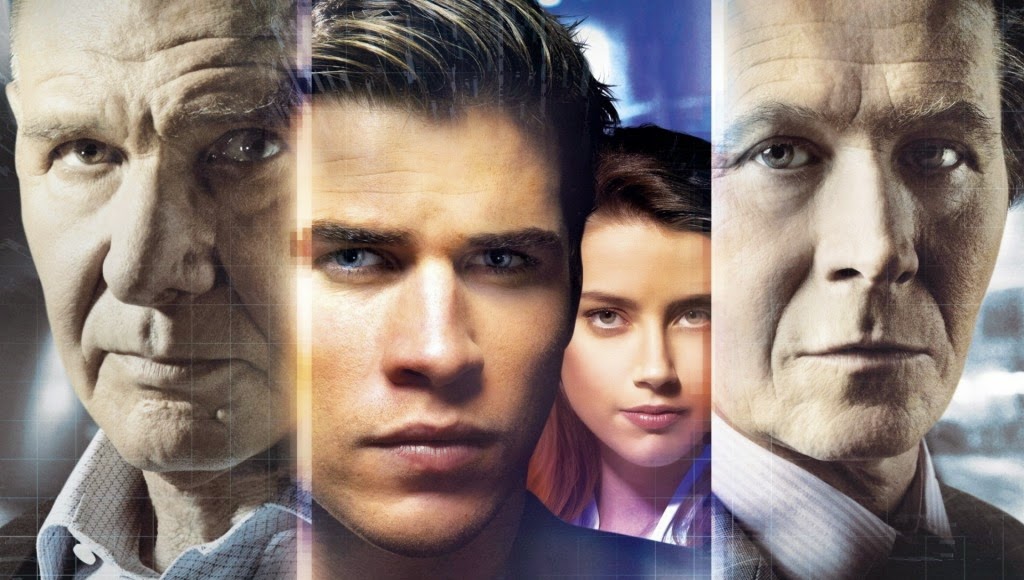
Paranoia —It’s an interesting, but not novel set up, pitting two aging, empire-building  computer mega execs against each other. It would be like watching Larry Ellison and Bill Gates at each other’s throats.  In this case, Harrison Ford and Gary Oldman are the dueling corporate heads and Liam Lambert is the hunky, supposedly brilliant pawn they maneuver to achieve their evil ends.  The film was directed by Robert Luketic and was based on the book of the same name by Joseph Finder. It’s always great to see Ford and Oldman, as well as Richard Dreyfuss who is also featured in this film you’ve seen before. Even so, this is a pleasant if somewhat mindless diversion.

Good People — Just a touch of greed. The tenant in a run-down home of a struggling young couple (James Franco and Kate Hudson) dies, leaving behind a pile of dangerous dough, residue from a double double-crossed dope deal.  The criminal doesn’t appear to have a next of kin and the cops have cleared his abode without discovering the stash. After a brief wait, the couple, (nice kids) decide to keep the money.  After all, what cold possibly go wrong? As it turns out there are two gangs who had been screwed over, and the police have more than a professional interest. There’s really no way they can do the right thing once things get going. Again, the plot is not exactly new.  Most plots aren’t. What we’re interested in here is how can two ordinary people deal with all the powerful and evil forces mounted against them and each other.   There is a certain amount of suspense.  However I kept thinking about Home Alone and how much more effective Macaulay Culkin was in his dealings against his home invaders.  Tom Wilkinson adds a more realistic dimension to the action, but this film, like Paranoia, wasn’t really ready for the big screen.  But again, while you will not be forced into hours of distressed thought about the meaning of life, the goodness or badness of humanity, there are entertaining moments. Good People was directed by Henrik Ruben Genz and based on a book by the same name, written by Marcus Sakey.

Both films were released in 2013 without fanfare and not much in the way of box office receipts.  As an accompaniment, maybe a Kalua and coffee or just coffee to provide that extra boost of energy.


Friday, May 4, 2012

Film Pairings — Small-Time Crooks And Great Small Crime Stories

When a writer or film director tries to tell odd, little stories, sometimes you end up with odd, little stories.  And Sonny is one of them.  I want to call it experimental; but there is nothing all that new or inventive about it. Perhaps it could be called an interesting exercise.  It is worth-while, perhaps an engaging curiosity.  Yet it is something out of the ordinary, well done and a chance to see what a talented young actor, James Franco, can do when given free reign. It is also a wonderful opportunity to watch the inimitable Harry Dean Stanton in a subtly meaty role.  If it interests you, Nicholas Cage shows what he did with this, his first directorial attempt.  He also makes a bizarre cameo appearance.

James Franco
The story is about Franco’s character, Sonny. He is a young man who returns to New Orleans and his brothel-owning mother after a couple of years in the Army. It appears that his military stint helped the young man sort out his life.  However, Mom, who trained her son to satisfy wealthy women for a fee, doesn’t want to let go of her prime earner, even though he’s decided to live a “normal “ life.  He just came by to say hello and goodbye. The story gets steamy and more complicated when a beautiful and sexy prostitute, played by sensuous Mena Suvari, shows up.  Her surprisingly tender, erotic presence muddies what otherwise would be a clear choice for the troubled young man.  This is Franco’s movie.  However, it is Stanton who makes it more than a high-quality student film.  Sonny was released in 2002.

Willem Dafoe
Paul Schrader directed Light Sleeper (1992), which is purportedly part of a Schrader trilogy that includes American Gigolo and The Walker.  Willem Dafoe plays the young man, a Manhattan drug dealer and former addict, who seriously contemplates getting out of narcotics altogether.  His drug business boss, Susan Sarandon, has already decided to go legit and may or may not help Dafoe in his desire to change his life. She implies she might, once she’s settled.  Just one last drug delivery.  That’s all she asks. Yeah, right.  One last heist.  One last hit. As you are likely to guess, the last delivery ends up disastrous and deeply personal. However, the predictable twist has a twist.  Light Sleeper is certainly the stronger of the two films.  Dana Delany plays a central character and, if you don’t make a quick trip to the bathroom, you’ll notice a funny little scene with David Spade — not exactly a man with a thousand faces.

I’m really at a loss to recommend drinks to accompany these films. New Orleans?  New York? I’m certainly NOT going to suggest that things go better with Coke.  You are on your own tonight.


Friday, December 9, 2011

Film Pairing — Tales of Two Fathers and Two Sons

By putting Perrier’s Bounty and City by the Sea together, we have a pair of father-son crime stories, both films with highly talented casts. While one is a dark comedy and the other merely dark, we have similar sensibilities at play. We also have, in my opinion, a similar sensitivity in the bright, young actors who play the wayward but highly redeemable sons — Cillian Murphy in Bounty and James Franco in City by the Sea.

Perrier’s Bounty (2011) is a twisted, quirky tale directed by Ian Fitzgibbon and narrated admirably by Gabriel Byrne. Set in Dublin, it stars Brendan Gleeson (In Bruges) as a crime boss who takes his own cruel actions as if they are personal affronts. “It’s devastating,” he says time and time again after doing something horrible. Jim Broadbent, convinced that if he goes to sleep he will die and that he will eventually sleep, believes he has nothing to lose by putting his life in danger. He is as hilariously courageous as he is a bad influence on his son, Murphy, who by fate and misjudgment makes all the wrong moves.

City by the Sea (2002) is a dark, violent thriller, sensitively set up and perhaps a bit too rushed at the end. Robert De Niro and Frances McDormand star in this gritty film that has more depth and less levity than Bounty. Set in New York — primarily a tremendously unap-pealing Long Island — the film is directed by Michael Caton-Jones who sets the action against this stark, desolated backdrop. Franco, who plays the son of a seasoned street cop, gives a moving portrayal of a young, petty criminal in way over his head.

It is not only interesting to compare the two young sons, but also the two fathers. Both of them seek some sort of redemption. Broadbent’s character is all too willing to help his son out of deep trouble as repayment for his own failure as a parent. De Niro, as Franco’s father, is a character with a lot of extra ethical baggage. Yes, ethical baggage. He is not at all eager to do the same for his lost son despite the fact the son deserves salvation.

Neither of the films received rave reviews when they were released. The comments were mixed at best. However, from my comfy sofa and flat screen TV, they were more than satisfying. I enjoyed the fine acting, the gritty cinematography and the drama much better than I would a couple of hours of long-in-the-tooth Law and Order SUV or the over-DNA’d CSI Miami.

It doesn’t matter which one you watch first. But, if you want to end on a lighter, more comedic note, do Perrier’s Bounty last. To accompany the evening, why not pour some Guinness? It works in New York and most certainly works for Dublin. And I’ve found a good, dark beer can add depth to the sadness and enhance the laughter.

CAPTION: Cillian Murphy (top), James Franco, (bottom).