Showing posts with label Film pairing. Show all posts

Friday, October 28, 2016

Film Pairings — The Laundry Business, From Colombia To Russia


Money from ill-gotten gains is no good unless you can spend it. So tonight is an examination of the money-laundering business. One of the two films is based on a true story about the days of Pablo Escobar in the 1980s. The other is a current classic British spy film soaked in Russian intrigue. These two films, released earlier this year, are not action oriented — though there is some of that. Even so they qualify as thrillers.


Our Kind of Traitor —If you like John le Carré, chances are you’ll like this understated film based on his novel starring a mature and impressive Ewan McGregor as well as scene-stealer Stellan Skarsgãrd.  The cinematography stars as well, with powerful imagery by Anthony Dod Mantle.  McGregor portrays an innocent professor who, believing he was merely doing a minor good deed, accidentally involves himself and his wife played by Naomie Harris in international intrigue, billions of dollars and the Russian mafia.  Directed by Susanna White, the film also features Damian Lewis, Alicia von Rittberg and Velibor Topic. This isn’t a naturally panoramic story, but it is played out in a big way, cinematically. It is also very much a story about the value of character.


The Infiltrator — Perhaps a bit less cinematic in scope, but with more grit. Bryan Cranston plays an aging (his last case?) special agent for the U.S. Custom Service. Based on agent Robert Mazur’s true-life novel, we visit Florida and the 1980s when there wasn’t enough room to store all of the drug war’s corpses until they could be disposed of.  Cranston, incredibly believable as Mazur, reveals the ugliness of the “good guys” as they attempt to contain evil while the plan to go against Escobar and his brutal Colombian cartel escalates in an increasingly deadly fashion. Among the film’s strengths are Cranston’s costars: John Leguizamo, Benjamin Bratt, Diane Kruger, Amy Ryan and Said Tghmaoui. Directed by Brad Furman, the film certainly has some tense and gruesome moments.

Well of course, what we sip during these two movies changes during intermission. No drinker would argue against vodka with the first. We have a chilly environment. Frilly drinks won’t work. However we make a drastic change when we arrive in Florida. Though there is nothing Cuban about the film,  we can cheat and try some of that new Cuban rum arriving on our shores.


Sunday, October 9, 2016

Film Pairing — Year Of The Con

Seems as if 2016 is the “Year of the Con,” with the election and all these candidates for public office pretending to be honest and competent, if not pious and brilliant. Let me recommend two films that pick up on the theme though in slightly different ways.  The first is light jazz. The second is visceral.  The first will make you smile.  The second will make you wince. Both are blessed with extreme talent. Both garnered film awards and considerable critical acclaim.  Both are based on true stories. The odd observation here is that the actors are pretending to be someone pretending to be someone they are not. Only actors and politicians are allowed to do that.

 Catch Me If You Can — This is the moment, I think, we catch Leonardo DiCaprio make his transition from vulnerable child star to adult without missing a step as a highly talented actor.  Here he portrays Frank Abagnale, upon whose book and life, the film is based. Young Frank grows up admiring his father, a man who despite his talent as a loving parent couldn’t quite make it as a provider despite or because of his con artist ways.  Frank, who occasionally participated in his father’s antics and wanting to impress his dad, took con artistry to a new level of fraud. With fake identities, he scammed millions eventually attracting a bland but determined pursuer, played exquisitely by Tom Hanks. Rounding out the supersized cast are Christopher Walken, Martin Sheen, James Brolin and Amy Adams.  The film, released in 2002, was directed by Steven Spielberg.


American Hustle — This is a considerably more down-to-earth film. While Catch Me If You Can has some serious undertones, it is a funny film. In American Hustle, the humor is there, certainly, but it is much, much darker.  Two con artists agree to scam an Arab sheik for a casino development in Atlantic City. An ambitious FBI agent catches on, and will throw them both in jail unless they help him bring down some dishonest politicians who would be caught with their hands in the till thereby helping the FBI agent make his bones at the Agency. If only humans didn’t have human failings. If only good was good and bad was bad and never the twain should met. Damn those gray areas. Damn that we should fall in love with stupid people who think they’re helping us but screw up our lives. Can’t I do a little wrong if the result is a greater good? Lots of questions. But answers?  Who is responsible for the answers?  Not the filmmakers. Based on the famous ABSCAM scandals of the ‘80s and directed by David O. Russell, the film was released in 2013. The gritty film is populated by incredibly fine actors giving fine performances at every level.  Christian Bale, Bradley Cooper, Amy Adams, Jeremy Renner, Jennifer Lawrence and Louis CK are featured. Robert De Niro makes a brief but powerful appearance.

Something to quench your thirst while you watch a couple of hours of disingenuous behavior? Champagne for the first. Light and bubbly, but with an ultimately calming effect.  For the second, you’ll have to get serious. Bourbon with no more than two ice cubes.  Or do what I do these days — some ice, tonic water, and a twist of lime or lemon. No alcohol.  People will think gin and tonic and you’ve pulled of a little scam of your own.


Wednesday, July 20, 2016

Film Pairing — Inner Directed, Outer Directed Movie Making

I grew up with adventure movies. The action was the plot.  The characters were essentially good or essentially bad.  We rooted for a good outcome. Good prevailed after a suitable period of doubt and fear.  This is the core of American movies in particular, which was all I saw before my teens and a little independence fueled by curiosity. The French not only introduced me to nudity, but to more complex characters.  Lately, American audiences have fallen in love with the cold, barren landscapes of Scandinavian countries and the complex emotions emanating from the darkness of the soul, sometimes ameliorating the significance, or enhancing the understanding of good and evil. Unlike the American products that focus on the external circumstances, the meat of many Scandinavian dramas comes from plunging into depth of character.

Point Break — This is an American film and surprisingly good, though relatively superficial.  I say surprisingly “good” because it is also a surfing and sky diving film with a series of powerful bank-robbing scenes.  Director Kathryn Bigelow makes the odd mix work, putting together an exciting couple of hours of adrenaline-infused sports adventure with Patrick Swayze and Keanu Reeves as criminal cat and FBI mouse on the thriller side.  The film, also featuring Gary Busey and Lori Petty, was released in 1991.  It was a major financial success and has evolved into a cult favorite. Ample male and female pulchritude. This is not to be confused with the remake.

The Absent One — Unlike the outer-directed Point Blank, this intense crime drama is focused on and propelled by investigating the depth of its characters, particularly a neurotic and obsessive cop brought in for cold case murders and a witness traumatized by the murder who is in hiding.  The film, released in 2014, is based on the novel by Jussi Adler-Olsen. It was directed by Mikkel Norgaard, and stars Nikolaj Lie Kaas, Fares Fares, Pilou Asbaek, David Dencik and Danica Curic, is set in Denmark. As we have come to suspect of Scandinavian crime films, the movement is slower, the screen is darker and the emotions richer than most of its American counterparts. Incidentally, there are three films in the Department Q series.

What to have while watching these two films: Akvavit or for something lighter, Carlsberg beer, which, very chilled, would also work for the beach scenes in Point Break. For the non-imbibers, we can always fall back on lemon and tonic water.

Sunday, November 22, 2015

Film Pairing – Relationships Going Very Wrong

I love movies.  I love things cinematic.  Life intensified, smoothed, edited and made to make sense, when, of course, that’s not life at all.  Here are two films that don’t make sense. But I believe them.  They don’t make sense in the way life doesn’t make sense. They are dark and unhappy. Sometimes that’s the way it is.

Break Up — Bridget Fonda is trapped in an abusive relationship.  She scrimps, saves, desperately trying to get a little money ahead so she can escape. She lives in a small, narrow world and. as if she has blinders, she can’t figure a way out except through this little passbook savings account. It is her hope, her only tunnel-visioned option. The abuser is killed in an auto accident.  Problem solved? Nope. The evidence points to her as prime suspect. Her instinct is to cash in and run. But the money is gone.  How can that be? Bridget Fonda is excellent. Kiefer Sutherland is effectively understated as the cop.  Steven Weber and Hart Bochner are also featured. The 1998 psychological thriller was directed by Paul Marcus with a well-written screenplay by Anne Amanda Opotowsky.

True Story — It is, apparently. And it is inert, in that it is barely a moving picture. Instead we have two strong actors facing off  – James Franco and Jonah Hill. Hill plays Michael Finkel, a discredited New York Times Reporter and Franco plays a murderer who takes Frankel’s identity to evade capture.  But captured he is and the writer might be too curious about why the murderer chose his identity. The two conspire to write the murderer’s story. Is it a way for both of them to redeem themselves? The 2015 film was directed by Rupert Goold and was based on — what else? — Finkel’s book. Franco’s character is psychopathic, Hill’s obsessive. They mirror each other in their narcissism, providing a double dose of self-absorption, which seems to explain the unavoidable attraction they have for each other.

These are small films, which is to say, minimal action, minimal actual violence no special effects. Just two human relationship stories.  The biggest fear is that what happened in these two movies could happen to us, or someone we love, and that we are too blind or too self-obsessed to see there is something larger out there.

Both are American films. A little Kentucky Bourbon would work as refreshments as youwatch Break Up. There would be nothing wrong with continuing that through True Story. For the non-inbibing, some fruit juice and soda will do fine.  And popcorn.  Why not? Though worth it, True Story is a little slow.


Monday, June 30, 2014

Film Pairing — Capote Times Two Or More, The Writing of In Cold Blood


While Breakfast At Tiffany’s may have been the most popular of Truman Capote’s books to make it to film and his most famous book, In Cold Blood solidified his place among America’s greatest writers. The book was considered part of a movement with various names — creative non-fiction, new journalism — that told a “factual” story with the emotion, plotting (and made-up, but in-the spirit-dialogue) to give the story the drama of fiction.  Hunter S. Thompson, Tom Wolfe and Norman Mailer, among others were celebrated practitioners of the style.

Historians disagree about who was the first writer to employ this new style, though most give Capote the nod for his tale of mass murderers headed for the death penalty. Capote was convinced that using his new style In Cold Blood would be his masterpiece and bring him a Pulitzer. In a strange and bitter twist of fate, Capote would be passed over.  However, a few years later, Norman Mailer would a receive the coveted Pulitzer for Executioner’s Song, a book about the death penalty in the case of murderer Gary Gilmore.  Talk about punishment.

The weirdness continued.  Two moviemakers, unbeknownst to each other, embarked on movie bios of Capote.  Both focused their films on just the narrow period in the author’s life that involved the writing of In Cold Blood.

Infamous (2006) was the second of the two to be released and immediately suffered from the well-deserved praise of the first.  It was based on another high-society celebrity writer turned realist, George Plimpton.  Relatively obscure actor Toby Jones (at least in the U.S.) played Capote.  Not only was he nearly Capote’s identical twin and an incredibly fine actor, he was perfect for this version of this time in Capote’s life that paid more attention to the author’s life as club-goer and society maven whose flamboyance made him a foreign invader of a down-to-earth small town in Kansas. Townspeople were flattered and shocked.  Infamous had a star-studded cast:  Sandra Bullock, Lee Pace, Daniel Craig, Gwyneth Paltrow and Sigourney Weaver.  Cast and crew have reason to be proud of this fine movie.

 Not to diminish Infamous, Capote (2005), the film, is nonetheless the more powerful of the two. Phillip Seymour Hoffman, as Truman, is not the dead-on copy that Toby Jones presented.  But this Capote delivers at a more meaningful level. Because of Hoffman and Dan Futterman’s script based on part of Gerald Clarke’s comprehensive biography, we see and understand a tragedy of classic proportions — Love of another versus love of oneself. This is the tragedy of Capote’s life.  I think the film is pretty much a masterpiece.

If you still have time on your hands, you can watch the highly regarded In Cold Blood (1967), the movie, with Robert Blake. To accompany An All-Capote evening, perhaps you would prefer to honor the author by dinking his favorite drink.  Make a pitcher of screwdrivers and put your car keys somewhere you won’t be able to find them.  And be comforted that least you’ll be getting your Vitamin C.


Film pairing, movie reviews, Truman Capote, Infamous, Phillip Seymour Hoffman, Toby Jones, Gerald Clarke, Norman Mailer, George Plimpton, Pulitzer Prize


Monday, November 11, 2013

Film Pairing — Two That Might Have Slipped Your Notice


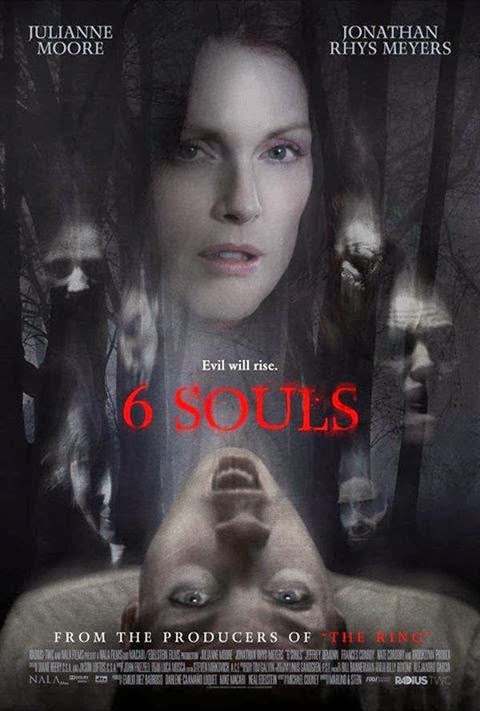
Julianne Moore is one of the finest actors you might not have noticed, though she has been nominated for an Academy Award four times. She often appears in offbeat films that prove challenging for critics and don’t quite meet box office expectations.  Among her many movies are: Far From Heaven, The Big Lebowski, The Hours, Savage Grace, The Kids Are All Right and A Single Man. However, two of her films seemed to have slipped through the cracks completely: Chloe, a semi-lovely erotic puzzle and 6 Souls, a gamble for even the most tolerant of audiences.

Chloe is a beautiful young woman confident she can bring sexual happiness to others and apparently sees no reason she shouldn’t be paid if that too brings pleasure to the other.  But nothing and no one are what they appear to be. It would be too easy and very wrong to say too much.  Liam Neeson plays the husband with a roving eye, but is it any more than an appreciation of beauty in passing? Julianne Moore is the wife who suspects her husband is having an affair. Is she more jealous than hurt? Amanda Seyfried is Chloe, the sex kitten who disturbs the entire dysfunctional family, including Max Theriot, the couple’s barely post pubescent son. Atom Egoyan directed this intelligent, steamy 2009 film.

The idea of dissociative identity disorder (multiple personality) in fiction was a trend for a while.  It was a great device for crime fiction in particular (Think Psycho). In 6 Hours (also released as Shelter), Julianne Moore finds herself trying to unravel the five people inhabiting Jonathan Rhys Meyers body and preventing the deaths that seem connected to them. It is meant to be a haunting story of one powerful evil spirit trying to keep himself alive.  The setting in part of Pennsylvania that time forgot makes some haunting cinematic moments.  The original idea, the cast and the cinematography are promising. In the end this is one of those films that can be watched and enjoyed with a talkative friend.

As the nights get colder and the films won’t keep you awake all on their own — though Chloe (2013) has some fascinating twists — I’d suggest some Irish coffee as an accompaniment to this double feature, most of your friends probably never heard of.


Friday, November 9, 2012

Film Pairing — Joan Crawford, Ready For Her Close-Ups And Ready For Murder


Using the vernacular of the times, Joan Crawford was a “tough broad,” and she usually played one. In both Mildred Pierce (1945) and in Sudden Fear (1952) she had the opportunity to reveal her ability to portray characters of a little more emotional depth.  She won an Academy Award for the title role in Mildred Pierce and received another nomination for her principal role in Sudden Fear.

Mildred Pierce was revived with a new production on Cable to high acclaim and is just one of many movies made from books by James M. Cain (The Postman Always Rings Twice and Double Indemnity among them).  The original b&w classic was directed by Michael Curtiz, who also did Casablanca.  William Faulkner reportedly contributed to the screenplay.  With Academy Award winning cinematographer Ernest Haller, who picks up great backdrops in Los Angeles (Pasadena and Santa Monica), behind the lens, there’s plenty of talent putting this classic altogether.

Mildred’s daughter, played by Ann Blyth, wants the good life.  She is ashamed of her mother’s lowly beginnings and prompts Crawford’s character to seek wealth and status by nearly any means to please her daughter’s ambition. Blyth is outstanding as the heartless, manipulative girl with the innocent façade.  She and Eve Arden were both deservedly nominated for Best Supporting Actress Academy Awards. Jack Carson plays a sleazy business partner and Zachary Scott is the slippery gigolo who gets it in the end and very much in the beginning.

My favorite of the two is Sudden Fear.  We spend most of this movie in San Francisco with Jack Palance trying to live off an extremely wealthy widow.  Joan Crawford plays the widow who is also an immensely popular playwright.  Palance is an actor who was 86’d from Crawford’s new play and is determined to get revenge — killing with kindness. Crawford is taken in by the romantic overtures, but by accident discovers that Palance and his criminally inspired girlfriend (noir’s standard bad girl, Gloria Grahame) want to do her in.  Hence, Sudden Fear.  But Crawford’s character is no pushover, and life and death become a bit more complicated for everyone. Like Mildred Pierce, Sudden Fear was nominated for a number of Awards including Academy nominations for Palance, costume design and cinematography — great work by Charles Lang, Jr.

My recommendation for drinks this drizzly cinematic evening is keeping is simple.  A fine whiskey, not the cheap stuff, goes well with the hard-drinking roles played by Crawford and her worldly friends.